By Emily Parrow
November 20, 2026
In the sixth installment of “Field Notes: Public History in the GAPE,” Digital Collections Cataloger and Archivist Ally Hecht shares information about the Theodore Roosevelt Center located at Dickinson State University in southwest North Dakota. The Center interprets the life, career, and legacy of America’s 26th president, one of the GAPE’s most influential figures, through a robust Digital Library, exhibit and research spaces, and public programming. In a modern era when information is polarizing, politicized, and often challenging to verify, Hecht explains how the Theodore Roosevelt Center’s efforts to collect, preserve, and share primary source materials is more important than ever.
Learn more at theodorerooseveltcenter.org and follow the Theodore Roosevelt Center on Substack, YouTube, and Facebook and Instagram @TheodoreRooseveltCenter.
Tell me a bit about your organization’s scope and focus. What makes it unique?
The Theodore Roosevelt Center (TRC) is dedicated to preserving and analyzing the legacy of Theodore Roosevelt and his contemporaries. To achieve this, we are proud to offer a Digital Library brimming with primary sources and a physical exhibit space on the Dickinson State University’s campus showcasing and interpreting our collections.
The TRC is best known for its Digital Library, the first comprehensive digital repository of Roosevelt’s correspondence, photographs, videos, and ephemera. To date, the TRC has cataloged and made available more than 138,000 records on its website. The Center focuses on item-level metadata and reconnecting disconnected chains of correspondence. Because the Presidential Library system had not yet been founded at the time of Roosevelt’s departure from the presidency in 1909, his papers—both professional and personal—were scattered between several institutions, including the Library of Congress and Harvard College Library, as well as historical societies, museums, and private collections throughout the country and the world. While many records have been digitized for increased access, chains of correspondence were often broken by creators, recipients, and institutions, with enclosures (like newspaper clippings or other letters) sometimes detached from related correspondence.
Because of these separations, it can be difficult for researchers to follow conversations or find relevant enclosures within these materials. It is also physically and financially difficult to travel to various locations around the country to view these collections. The TRC aims to make the research process easy: everything is in one place, chains of correspondence are reunited, and item-level metadata assists researchers to quickly find what they are looking for.
How does your organization interpret GAPE history? What tools are you using?
The great thing about the TRC is we catalog and collect primary sources for users to interpret on their own. While staff offer insight into the materials on our website in the form of annotations, encyclopedia articles, and posts on Substack and social media, we aim to stick to the facts and back up our interpretations with primary sources like letters and speeches to understand exactly what Theodore Roosevelt believed.
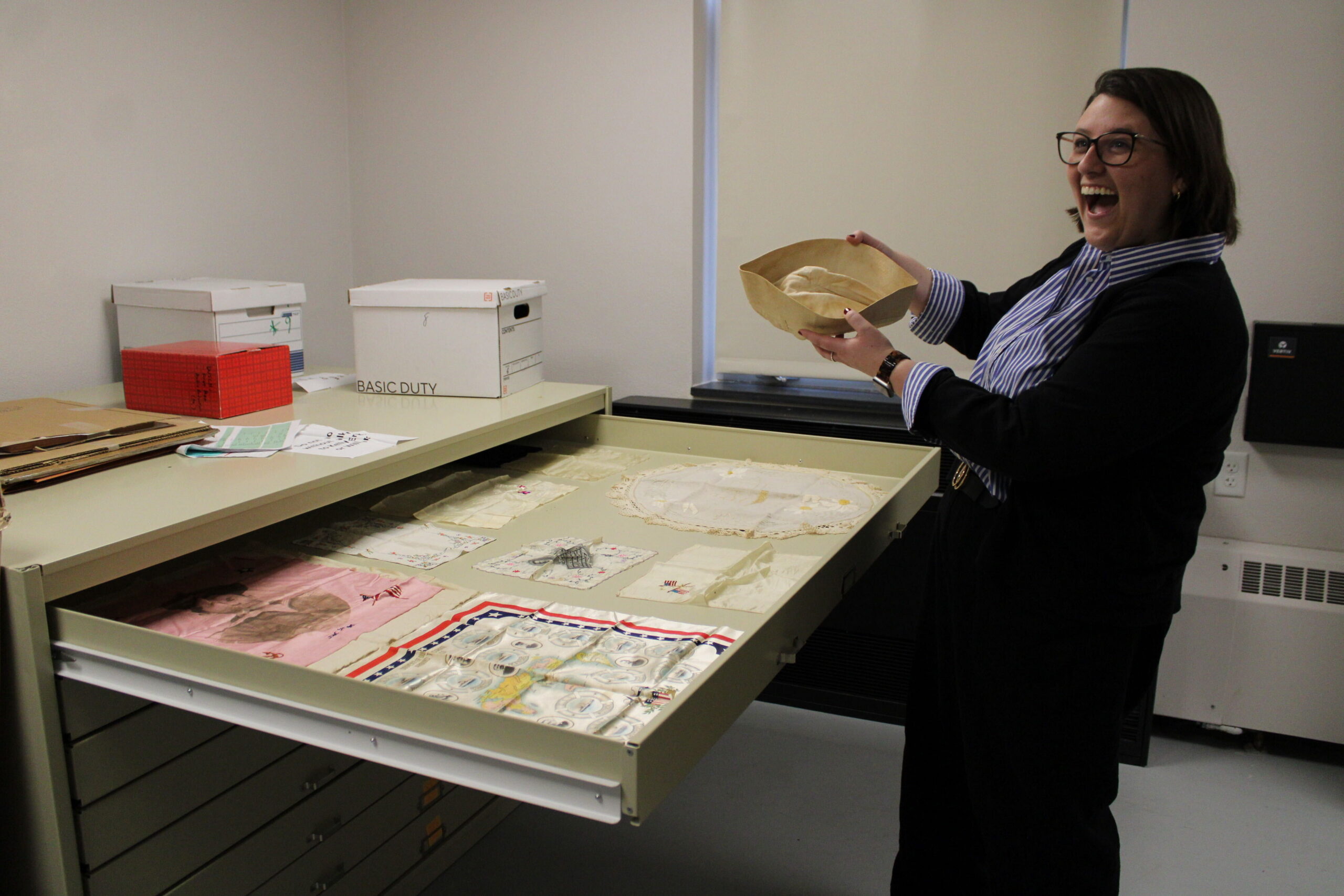
We also use physical objects to engage visitors. An amberola with a wax cylinder of Roosevelt’s 1912 speech, “The Right of the People to Rule,” and a copy of Roosevelt’s book The Wilderness Hunter, with a drawing of dogs around a bonfire sketched by Roosevelt himself, are kept in our Reading Room for people to hear and see. The Reading Room features the same style of wallpaper and woodworking as Roosevelt’s library at Sagamore Hill in Oyster Bay. While not an exact replica of that space, we hope the Reading Room gives our visitors a taste of Sagamore Hill’s library, despite being thousands of miles away in North Dakota.
I also help bring the Roosevelts and their era alive for our younger guests. Last year, I created coloring pages from historical photographs available in our Digital Library to help illustrate the lives of the Roosevelts during the GAPE. Additionally, children’s activity sheets, like a Roosevelt word search and a scavenger hunt for our current exhibit, “Theodore Roosevelt and the Navy,” are also available free of charge on our website and in our physical exhibit space.
Tell me about your current position. What does a typical day look like for you?
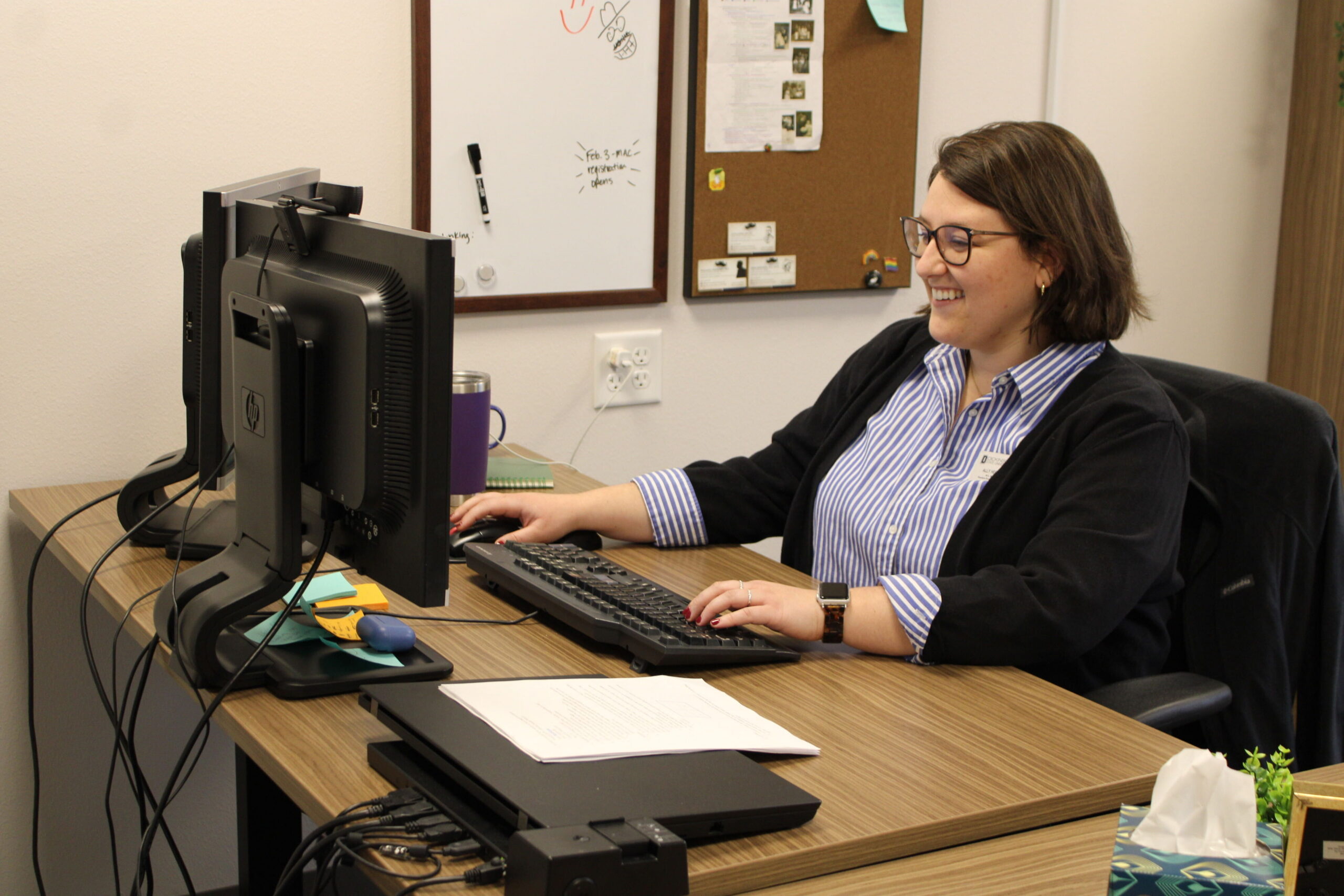
What’s fun about my current position is there is no typical day at the TRC! Last year, the Center set a goal to publish 135,000 records on our website. Because of this, I spent many days completing item-level cataloging on records in our Digital Library. One of my favorite collections to catalog was that of Charles C. Myers, a sailor in the U.S. Navy who served in Roosevelt’s Great White Fleet. During his travels, he collected more than 900 postcards from all over the world and wrote corresponding narratives about the places he saw and the people he met. We used the Myers collection as a jumping off point for our 2025 Theodore Roosevelt Center symposium, and it is prominently featured in our current exhibit, “Theodore Roosevelt and the Navy,” which I also helped to create last year.
This year, I have shifted more of my focus to organizing our physical archival collections. While the Digital Library is a focus for the TRC, we do have a small (but growing) collection of documents, books, ephemera, and artwork. I spend some days rehousing our existing collections and organizing institutional paperwork, while other days are spent accessioning incoming donations. With America250 celebrations underway, the TRC has been involved with preparations for the musical performance of Teddy & Alice: An American Musical, performed on the Dickinson State University campus from July 2-6. For this event, I created coloring sheets and planned guided tours for those visiting during the holiday week.
Each summer, the TRC offers a remote internship for eight graduate students pursuing history, library and information science, or archival management degrees to catalog records in our Digital Library and create digital humanities projects with materials from our collections. For most of the summer, my time is spent guiding the interns through this experience, and as a prior TRC intern, I enjoy this aspect of my work the most! The last two years have each seen more than 200 applicants, which emphasizes the interest in the sort of work we do. The Center also has a robust volunteer program and several student workers, whom I help oversee. You never know what interesting items they will find or questions they will have, so it keeps me on my toes.
Can you describe a noteworthy finding, exciting research rabbit trail, encouraging public response, or other insight that occurred through your work?
Some of my favorite items available in the TRC’s Digital Library are letters from children to Roosevelt and his responses. In one letter, a young girl named Mary Doyle asks Roosevelt (recently returned from his safari), “what kind of animal is a unicorn?” In another letter, a young boy named Theodore W. Christian writes to tell Roosevelt that he was named after him. As an African-American boy from Tennessee, Christian believes he won’t become president, but he wishes to grow up to be just like his namesake nonetheless. In his response, Roosevelt addresses Christian as “my dear young friend” and signs the letter “Your friend.”
Roosevelt also wrote sweet illustrated letters to his own children, often depicting scenes of the family getting into mischief or animals he encountered on his hunts. Roosevelt’s sketches and affection for children—his own and strangers’—illuminate his fatherlike tendencies, offering an alternate view of the Rough Rider, the President, and the hunter.
Who is your audience? Does that shape your presentation of this history?
The Center was founded with researchers in mind. However, our goal is that everyone, young or old, professional or simply curious, leaves our physical exhibit space or our website with a better understanding of who Roosevelt was. With this in mind, we have attempted to keep our website search options intuitive and our interpretation unbiased. We also aim to reach the general public with our work. The Center hosts an annual symposium, welcoming visitors to campus and covering topics like Roosevelt and the Navy, conservation and sustainability, and Roosevelt’s role in modern sports. Videos of our symposia are available on our YouTube channel.
Our Outreach Coordinator has also presented at various conferences, the Presidential Primary Sources Project, and the Truman Library’s annual Teachers Conference. In addition to offering children’s activities, we have welcomed school groups, presented show-and-tells of our archival collections, and recently purchased a standee of Roosevelt as a fun photo op.
How do you think the GAPE is reflected in our contemporary moment? What can the public learn from your organization/work?
The power of primary sources cannot be overstated in a contemporary moment when the purported threat of “fake news” is screamed from the hillsides by politicians and public figures, AI is hallucinating answers, and misinformation is widely spread. The TRC attempts to make locating primary sources easier so people can learn for themselves what Roosevelt said, believed, and wrote. Roosevelt was involved in and held opinions on so many topics: personal character, parenting, citizenship, immigration, military power, protection of natural resources, and more. Researchers can often find their modern interests reflected in Roosevelt’s GAPE writings.
Alexandra (Ally) Hecht is a Digital Collections Cataloger and Archivist at the Theodore Roosevelt Center. She earned both her M.A. in History and M.L.I.S. from Simmons University in Boston, Massachusetts. She works with the TRC’s physical and digital collections and guides interns and volunteers year-round. Connect with Ally on LinkedIn.


Emily Parrow
A Content Editor for the SHGAPE Blog, Emily Parrow is an independent GAPE scholar with a background in museums and public history. She lives in Rhode Island, where she serves on the Preservation Society of Newport County’s fundraising team. Her M.A. thesis explored the physical and social evolution of nineteenth-century Newport through the eyes of social arbiter Ward McAllister. Most recently, she co-authored an article on President Chester A. Arthur.